
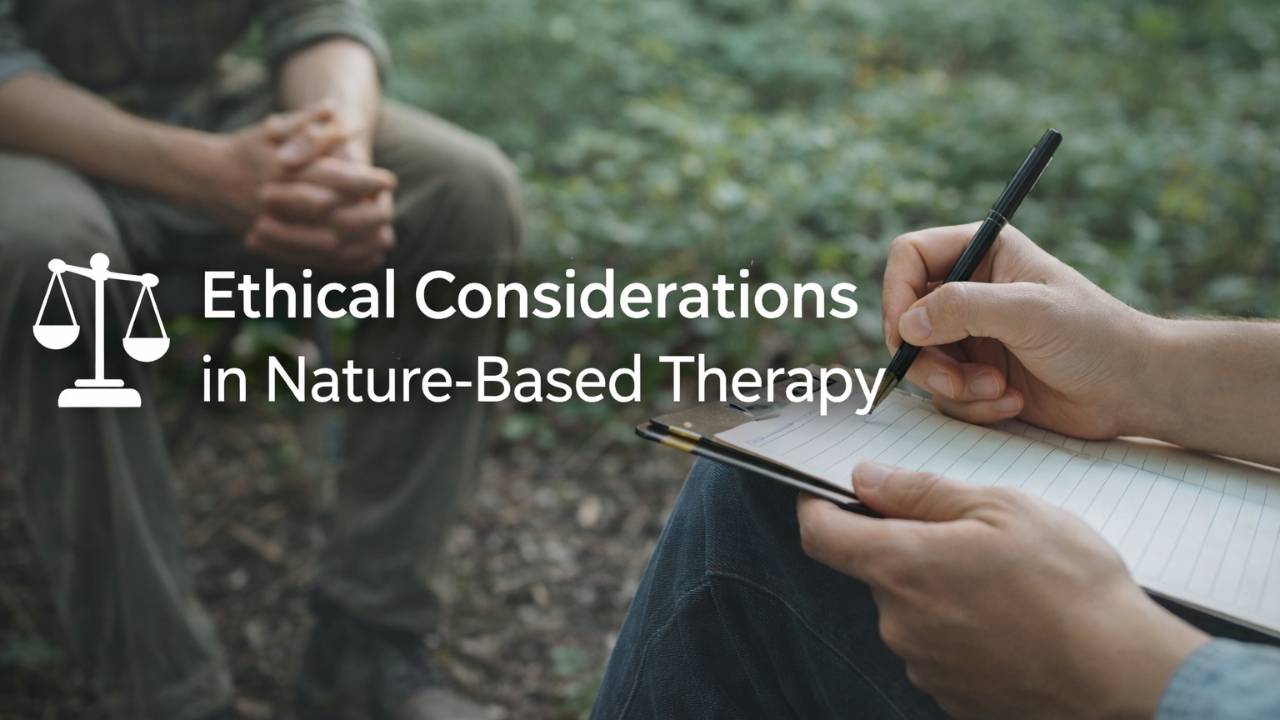
Ethical Considerations in Nature-Based Practice
Ethical Framework: Quick Navigation
Key considerations for trauma-informed and ecotherapy-informed practice.
Nature-based practice can be powerful, but powerful approaches require careful ethical consideration.
Working outdoors does not remove professional responsibility. In many cases, it increases it.
Ethical nature-based practice requires clarity around safety, consent, cultural awareness, competence, and scope of practice.
Below are key considerations for trauma-informed and ecotherapy-informed practitioners.
1. Scope of Practice and Professional Boundaries
Practitioners must remain within their qualifications and training.
Professional ethical codes across psychology, counselling, and social work emphasise competence, ongoing supervision, and adherence to scope of practice (Australian Psychological Society [APS], 2018; Psychotherapy and Counselling Federation of Australia [PACFA], 2017).
Ecotherapy should not exceed a practitioner’s clinical competence. When working with trauma or complex mental health conditions, referral pathways and collaborative care are essential.
2. Informed Consent in Outdoor Settings
Informed consent in nature-based therapy must include environmental factors.
Ethical guidelines emphasise transparency regarding risks, limitations of confidentiality, and foreseeable hazards (APS, 2018; American Psychological Association [APA], 2017).
Outdoor practice requires clients to understand:
- Environmental unpredictability
- Physical terrain risks
- Public visibility
- Accessibility constraints
Consent should be ongoing, not assumed.
3. Physical and Environmental Safety
Outdoor behavioural healthcare literature highlights the importance of structured risk assessment, emergency planning, and environmental awareness (Gass et al., 2020).
Practitioners must consider:
- Climate exposure
- Terrain hazards
- Allergies and wildlife
- Client physical capacity
Trauma-informed care also emphasises physical and emotional safety as foundational (Substance Abuse and Mental Health Services Administration [SAMHSA], 2014).
4. Cultural Awareness and Country
In Australia, ethical practice requires cultural responsiveness and respect for First Nations peoples.
Cultural safety frameworks emphasise humility, consultation, and non-appropriation of Indigenous knowledge (Dudgeon et al., 2014).
Ecotherapy practitioners must avoid replicating or adapting Indigenous healing practices without permission, training, or cultural authority.
Respect for Country includes recognition of land as relational, not merely therapeutic backdrop.
5. Confidentiality in Outdoor Practice
Professional ethical codes clearly outline confidentiality responsibilities (APA, 2017; APS, 2018).
Outdoor sessions introduce challenges such as:
- Overheard conversations
- Unplanned encounters
- Data security concerns
These limitations must be discussed clearly with clients in advance.
6. Trauma-Informed Environmental Choices
Trauma-informed frameworks highlight safety, choice, collaboration, trustworthiness, and empowerment (SAMHSA, 2014).
Nature is not universally regulating. Certain landscapes may trigger hypervigilance or emotional activation.
Practitioners should assess individual responses, offer agency, and monitor arousal levels — aligning with trauma research emphasising bottom-up regulation (van der Kolk, 2014).
7. Power Dynamics and Dependency
Ethical frameworks emphasise avoidance of exploitation, dual relationships, and undue influence (APA, 2017; APS, 2018).
Nature-based settings can intensify emotional experiences. Practitioners must avoid positioning themselves as spiritual authorities or exclusive sources of healing.
Supporting autonomy and client agency remains central.
8. Environmental Responsibility
Environmental ethics intersect with therapeutic ethics.
Ecopsychology literature highlights reciprocity and ecological responsibility (Roszak et al., 1995).
Practitioners should follow environmental best-practice principles such as:
- Leave No Trace guidelines
- Sustainable material use
- Respect for biodiversity
Therapeutic practice should not degrade ecological systems.
9. Documentation and Professional Accountability
Outdoor work should cognizant be documented to the same professional standards as indoor therapy.
This includes:
- Session notes
- Risk assessments
- Insurance coverage
- Incident reporting
Professional indemnity policies must explicitly include off-site or outdoor practice.
10. Integration and Aftercare
Trauma-informed care emphasises grounding, containment, and stabilisation before session closure (SAMHSA, 2014).
Nature-based sessions may evoke strong emotional responses. Ethical care includes:
- Structured debriefing
- Emotional regulation before departure
- Clear follow-up processes
Ethics ensures safety, professionalism, and sustainability in practice.
References
American Psychological Association. (2017). Ethical principles of psychologists and code of conduct. https://www.apa.org/ethics/code
Australian Psychological Society. (2018). Code of ethics. APS.
Dudgeon, P., Milroy, H., & Walker, R. (Eds.). (2014). Working together: Aboriginal and Torres Strait Islander mental health and wellbeing principles and practice (2nd ed.). Commonwealth of Australia.
Gass, M. A., Gillis, H. L., & Russell, K. C. (2020). Adventure therapy: Theory, research, and practice (2nd ed.). Routledge.
Psychotherapy and Counselling Federation of Australia. (2017). PACFA code of ethics. PACFA.
Roszak, T., Gomes, M. E., & Kanner, A. D. (1995). Ecopsychology: Restoring the earth, healing the mind. Sierra Club Books.
Substance Abuse and Mental Health Services Administration. (2014). SAMHSA’s concept of trauma and guidance for a trauma-informed approach. U.S. Department of Health and Human Services.
van der Kolk, B. A. (2014). The body keeps the score: Brain, mind, and body in the healing of trauma. Viking.
Disclaimer: This content is for educational purposes and provides information on nature-based wellbeing practices. It is not a substitute for professional medical advice, diagnosis, or treatment. If you are experiencing clinical symptoms or mental health challenges, please consult a licensed mental health professional.
Ready to take the next step?
Understanding ecotherapy is the first step. Applying it safely, ethically, and effectively requires structure, ethical clarity, and real-world planning skills.
If you are considering specializing in nature-informed practice, you are invited to join the first preview lesson — free of charge — to explore the foundations of ecotherapy-informed integration and determine whether this professional pathway aligns with your goals.
For those seeking structured training that moves from foundations → techniques → ethics → risk management → program design, you can explore the Professional Certificate in Ecotherapy-Informed Practice.
Join Our Professional Community
Join an international network of practitioners. Get the latest research summaries, framework tools, and case studies delivered to your inbox, plus first access to our retreats and events.
As a gift, we will send you the EcoPsychology.Co Introduction Guide, a gentle introduction to the human-nature connection and nature-based wellbeing.